A good nighttime skincare routine does not need to include a long list of expensive products. In fact, a simple routine that you can follow consistently is often easier to maintain than a complicated 10-step regimen.
Your evening routine is a chance to cleanse your skin, remove makeup and sunscreen, apply products suited to your skin’s needs, and moisturize before you go to bed. The right order can also make your routine easier to follow and help you avoid using unnecessary products.
Whether you have dry, oily, combination, or sensitive skin, the basics are similar. What changes is the type and number of products you choose.
This guide explains the best skincare order at night, what each step does, which steps are optional, and how to simplify your routine if you are just getting started.
Why Have an Evening Skincare Routine?
Throughout the day, your skin comes into contact with makeup, sunscreen, sweat, oil, dirt, and environmental debris. Cleansing before bed helps remove these substances so you are not going to sleep with the day’s buildup on your skin.
A nighttime routine also gives you an opportunity to use products that fit your individual skincare goals. Depending on your skin type and concerns, that might mean focusing mainly on hydration or occasionally incorporating a treatment product. If you’re also interested in creating a complete routine focused on healthier-looking, glowing skin, see our guide to a skin care routine for a glow up.
The important thing is not how many products you use.
Consistency matters more than having a complicated routine.
Dermatologists generally recommend keeping skincare relatively simple and avoiding unnecessary products that can irritate the skin. The American Academy of Dermatology recommends a basic approach built around cleansing, moisturizing, and protecting the skin from the sun, while treatments can be added according to individual needs.
Nighttime Skincare Routine Order
If you want a simple answer to the question “What is the correct skincare order at night?”, start with this:
| Step | Product | Purpose |
|---|---|---|
| 1 | Remove makeup and sunscreen | When needed |
| 2 | Gentle cleanser | Cleanses the skin |
| 3 | Toner or essence | Optional hydration step |
| 4 | Treatment or serum | Targets a specific skincare concern |
| 5 | Eye product | Optional |
| 6 | Moisturizer | Helps keep skin hydrated |
| 7 | Overnight treatment | Optional final step |
You do not need every step listed above.
For many people, a simple evening skincare routine can be just:
Cleanser → treatment or serum → moisturizer
If your skin is easily irritated, even fewer products may be appropriate.

Step 1: Remove Makeup and Sunscreen
If you wear makeup or sunscreen during the day, removing it is an important first step in your evening routine.
You can use a makeup remover, cleansing balm, cleansing oil, micellar water, or another product designed for this purpose. The best option depends on your skin and what you are trying to remove.
You do not necessarily need a complicated double-cleansing routine every night. What matters most is that you remove makeup, sunscreen, and daily buildup before applying the rest of your skincare products.
Be gentle around the eyes. Rubbing aggressively can cause unnecessary irritation.
If you do not wear makeup and your cleanser effectively removes your sunscreen and daily buildup, you may be able to keep this step very simple.
Step 2: Cleanse Your Skin
After removing makeup and sunscreen, cleanse your face with a gentle cleanser.
Cleansing removes oil, dirt, sweat, and other substances that have accumulated on your skin during the day.
Use lukewarm rather than very hot water and avoid aggressively scrubbing your face. Harsh cleansing can leave skin feeling tight and uncomfortable, particularly if you already have dry or sensitive skin.
The American Academy of Dermatology recommends gently cleansing the skin and patting it dry rather than rubbing it aggressively.
A cleanser should leave your skin feeling clean without making it feel stripped.
If your face feels extremely tight immediately after cleansing, that may be a sign that the cleanser or cleansing method is too harsh for your skin.

How to Choose a Cleanser
Your skin type can help guide your choice:
- Dry skin: Look for a gentle, moisturizing cleanser.
- Oily skin: A lightweight cleanser may feel more comfortable.
- Combination skin: Choose something that cleanses without excessively drying the skin.
- Sensitive skin: A gentle, fragrance-free option may be preferable.
- Acne-prone skin: Look for products labeled non-comedogenic or “won’t clog pores.”
If you have a persistent skin condition or significant irritation, a dermatologist can help determine which products are appropriate.
Step 3: Apply Toner or Essence — Optional
Toner is not an essential part of every evening skincare routine.
Modern skincare routines often include toners or essences because they can provide hydration or prepare the skin for subsequent products. However, you do not need one simply because skincare routines online include it.
If you enjoy using a toner or essence and your skin tolerates it well, you can apply it after cleansing.
If your skin is sensitive, there is nothing wrong with skipping this step.
A shorter routine is still a complete routine.
That is especially important if you are trying to identify what works for your skin. Adding several products at once makes it harder to know which one is helping or causing irritation.
Step 4: Apply a Serum or Treatment
After cleansing, you can apply a serum or treatment product if you have a specific reason for using one.
This is the part of your evening skincare routine where you might address a particular concern, such as dryness, uneven-looking skin, or breakouts.
Treatment products vary considerably, so you should follow the directions for the specific product you are using.
Some common skincare ingredients include:
- Hyaluronic acid serum for hydration
- Niacinamide for a variety of skincare concerns
- Salicylic acid for exfoliation and acne-related concerns
- Retinol or retinoids for certain skin concerns
- Vitamin C is more commonly associated with morning routines, although product instructions can vary
Do not assume that using more active ingredients will automatically produce better results.
In fact, combining too many potentially irritating products can make your routine harder on your skin. The AAD specifically warns that using too many products, particularly multiple anti-aging products, may irritate the skin.
Introduce New Treatments Slowly
If you are adding a new active ingredient to your routine, avoid changing several products at the same time.
A simple approach is to introduce one new product and give your skin time to adjust.
If a product causes significant burning, swelling, or persistent irritation, stop using it and consider speaking with a dermatologist.
Step 5: Eye Cream — Optional
Eye cream is another optional part of an evening skincare routine.
You do not necessarily need a separate eye product. Depending on the formula and your skin, your regular moisturizer may be enough for the area around your eyes.
If you do use an eye cream, apply a small amount and avoid getting the product directly into your eyes.
There is no need to aggressively rub the delicate skin around the eye area.
Step 6: Moisturize
Moisturizer is one of the most useful basic steps in an evening skincare routine.
It helps support the skin’s moisture barrier and can help reduce the feeling of dryness or tightness.
The best moisturizer depends on your skin type.
For Dry Skin
Choose a richer moisturizer if your skin tends to feel dry, rough, or flaky.
Applying moisturizer while the skin is slightly damp can help lock in moisture. The AAD recommends moisturizing regularly and notes that moisturizer can be particularly important for relieving dry skin.
For Oily Skin
Having oily skin does not mean you should automatically skip moisturizer.
A lightweight, non-comedogenic moisturizer may be more comfortable than a heavy cream.
For Combination Skin
You may prefer a lightweight moisturizer across the face and a little more product on areas that become dry.
For Sensitive Skin
Keep the routine simple and look for products that your skin tolerates well. Fragrance-free products may be preferable if fragrance tends to irritate your skin.
Step 7: Add an Overnight Treatment — Optional
Some people like to finish their routine with an overnight moisturizer.
This is not necessary for everyone.
If your moisturizer already provides enough hydration, you can stop there.
The goal is not to create the longest possible routine. The goal is to create a routine that makes sense for your skin and your lifestyle.
How to Layer Skincare Products at Night
One of the most common skincare questions is how to layer products correctly.
A useful general rule is to move from lighter products to heavier products, while also following the specific directions provided by individual products. The American Academy of Dermatology provides guidance on skincare product order in which skincare products should be applied.
A simple example is:
Cleanser → treatment/serum → moisturizer
If you use several products, check their instructions rather than assuming that every product should be layered together.
The American Academy of Dermatology recommends cleansing first, applying treatments next, and then applying moisturizer and/or sunscreen as appropriate. Sunscreen belongs primarily in your daytime routine, not as a final nighttime step.
Do You Need to Wait Between Skincare Steps?
You generally do not need to spend several minutes waiting between every product.
Apply products as directed and allow each layer to absorb comfortably before applying the next one if needed.
The more important issue is product compatibility and avoiding unnecessary irritation, rather than following an elaborate waiting-time schedule.
Skincare for Different Skin Types at Night
There is no single routine that works perfectly for everyone.
Your skin type can help determine which products you need and which ones you may want to avoid.
| Skin type | Simple nighttime routine |
| Dry | Gentle cleanser → hydrating treatment → moisturizer |
| Oily | Gentle cleanser → lightweight treatment → moisturizer |
| Combination | Cleanser → targeted treatment → moisturizer |
| Sensitive | Gentle cleanser → simple hydrating product → fragrance-free moisturizer |
| Normal | Cleanser → optional treatment → moisturizer |
These are starting points rather than strict rules.
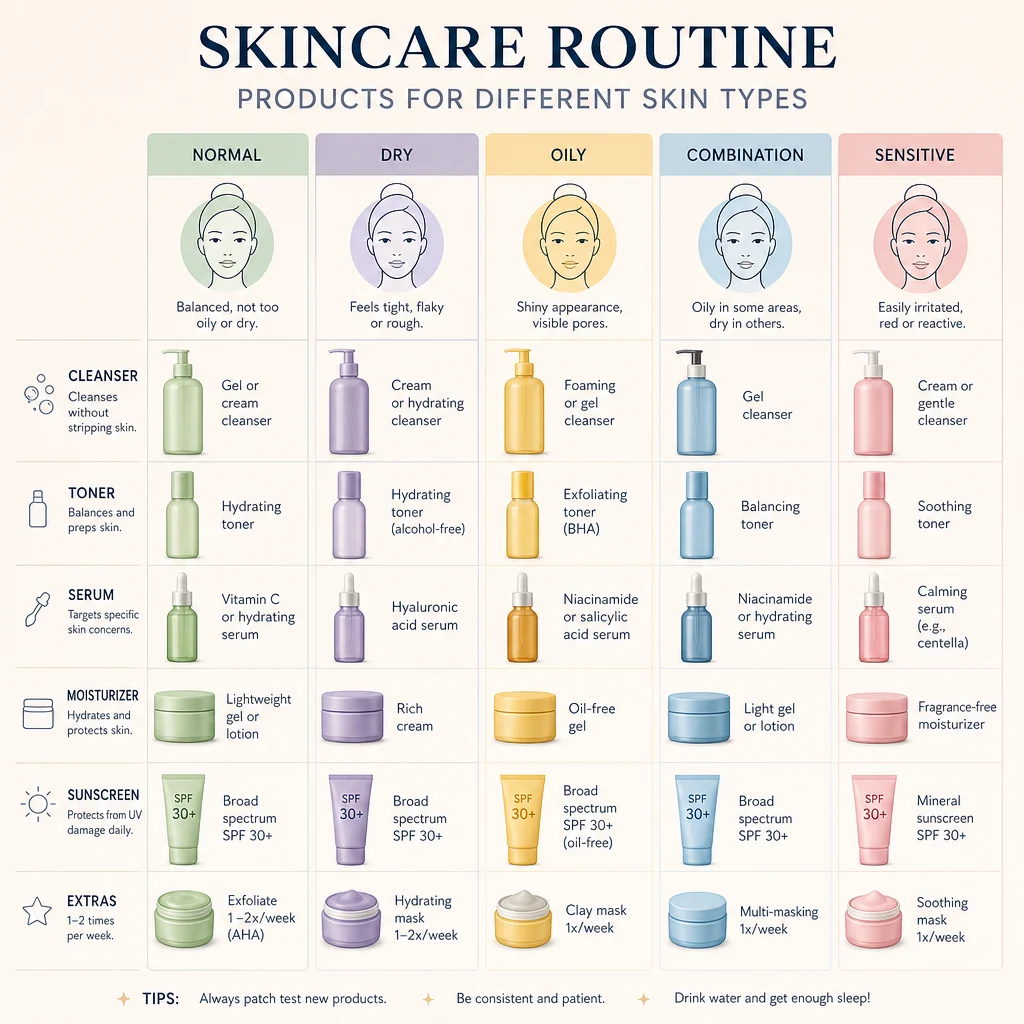
Your skin can also change with weather, age, hormones, medications, and other factors, so your routine may need to change over time.
Simple Evening Skincare Routine for Beginners
If you are completely new to skincare, do not start with seven or eight products.
Start with three:
1. Cleanser
Use a gentle cleanser to remove the day’s buildup.
2. Moisturizer
Apply a moisturizer appropriate for your skin type.
3. One Optional Treatment
Once you are comfortable with the basic routine, you can consider adding a treatment that addresses a specific concern.
This approach makes it easier to understand what your skin likes and dislikes.
You do not need a 10-step evening skincare routine to take good care of your skin.
A simple routine followed consistently can be much more practical than a complicated routine that you abandon after a few weeks.
Evening Skincare Routine for Dry Skin
If your skin feels tight, rough, or flaky in the evening, focus on gentle cleansing and hydration.
A simple routine might look like:
Gentle cleanser → hydrating serum → moisturizer
You can also skip the serum if your moisturizer provides enough hydration.
Avoid excessively hot water and harsh scrubbing, both of which can make dryness feel worse.
If your skin remains excessively dry despite changing your routine, or if you experience persistent itching, burning, cracking, or irritation, consider consulting a dermatologist.
Evening Skincare Routine for Oily Skin
Oily skin still needs hydration.
A common mistake is trying to remove every trace of oil with harsh cleansers or skipping moisturizer completely.
Instead, consider a simple routine:
Gentle cleanser → lightweight treatment → lightweight moisturizer
Look for products labeled non-comedogenic if clogged pores or breakouts are a concern. The AAD recommends looking for terms such as non-comedogenic, non-acnegenic, or oil-free when selecting skincare and haircare products for acne-prone skin.
Evening Skincare Routine for Sensitive Skin
Sensitive skin often benefits from a less-is-more approach.
Instead of adding multiple active ingredients, focus on:
- Gentle cleansing
- Simple hydration
- A moisturizer your skin tolerates
- Introducing new products gradually
If you notice burning, stinging, redness, or peeling after adding a product, do not assume that the discomfort means the product is “working.”
Some active ingredients and exfoliating products can increase irritation, particularly when combined. The AAD recommends considering the products you already use before adding exfoliation because certain treatments can make skin more sensitive or dry.
Common Nighttime Skincare Mistakes
Even a well-planned evening skincare routine can become ineffective or irritating if you make a few common mistakes.
Using Too Many Products
More products do not necessarily mean better skin.
Adding several active ingredients at once can increase the chance of irritation and makes it difficult to determine which product is responsible for a reaction.
Skipping Cleansing Before Bed
Going to bed without removing makeup, sunscreen, sweat, oil, and daily buildup is not a good habit.
If you are exhausted, keep your routine simple rather than skipping it completely.
Scrubbing Too Hard
Your skin does not need aggressive scrubbing to be clean.
Gentle cleansing is usually a better approach than repeatedly stripping or scrubbing the skin.
Changing Your Entire Routine at Once
If you replace five products simultaneously and your skin reacts, you may not know which product caused the problem.
Introduce changes gradually whenever possible.
Assuming Expensive Products Are Better
Price alone does not determine whether a skincare product is right for your skin.
Dermatologists emphasize that effective skincare does not have to be expensive, and simplifying your routine can reduce both cost and the risk of irritation.
Forgetting About Your Morning Routine
A nighttime routine is only one part of daily skincare.
Sun protection belongs in your daytime routine. Broad-spectrum sunscreen is an important part of protecting skin from UV exposure, and the FDA recommends using sunscreen along with other sun-protection measures. For more information, see FDA sunscreen guidance.
Should You Exfoliate at Night?
Exfoliation can be useful for some people, but it is not something everyone needs to do every night. The American Academy of Dermatology explains how to exfoliate safely based on your skin type and existing products.
Chemical exfoliants use ingredients such as alpha hydroxy acids or beta hydroxy acids, while mechanical exfoliation physically removes dead skin cells.
Using exfoliating products too frequently can irritate the skin, particularly if you are already using other active ingredients.
The AAD recommends considering the products already in your routine before exfoliating because some treatments can increase sensitivity or peeling.
If you choose to exfoliate, follow the product instructions and avoid assuming that daily use is necessary.
Do You Need a Different Routine Every Night?
No.
For most people, the foundation of a nighttime skincare routine can remain consistent.
You might use your basic routine most nights and add a particular treatment only according to its directions.
For example:
Most nights:
Cleanser → moisturizer
Treatment nights:
Cleanser → treatment → moisturizer
This can be easier to maintain than creating a completely different routine for every day of the week.
How Long Should Your Evening Skincare Routine Take?
Your routine can take just a few minutes.
A basic routine might be completed quickly:
- Remove makeup or sunscreen.
- Cleanse.
- Apply your treatment if you use one.
- Moisturize.
You do not need to spend 30 minutes in front of the bathroom mirror every night.
The best evening skincare routine is one that is realistic enough for you to follow consistently.
What Should You Avoid Putting on Your Face at Night?
There is no universal list of products that everyone must avoid at night.
Instead, be careful with products that cause irritation or that are being used incorrectly.
Be especially cautious about:
- Combining several strong active ingredients without understanding how they interact
- Excessive exfoliation
- Harsh scrubbing
- Products that repeatedly cause burning or irritation
- Using products in ways that conflict with their directions
If you have a diagnosed skin condition or are using prescription medication on your skin, follow the instructions from your healthcare professional rather than copying a generic online routine.
The Simple Version of Your Evening Routine
If everything above feels like too much information, remember this:
Step 1: Cleanse your skin.
Step 2: Apply a treatment if you need one.
Step 3: Moisturize.

That’s it.
You can add toner, essence, eye cream, masks, exfoliants, or other products if they serve a purpose for your skin, but none of them are mandatory for everyone.
A good routine is not defined by the number of bottles sitting on your bathroom counter.
It is defined by whether the products are appropriate for your skin and whether you can use them consistently without causing unnecessary irritation.
Frequently Asked Questions About Evening Skincare Routines
What is the correct evening skincare routine order?
A simple order is cleanser → treatment or serum → moisturizer. Optional products such as toner, essence, eye cream, or an overnight treatment can be added depending on your needs and the directions for the products you use.
How many steps should an evening skincare routine have?
There is no required number of steps. A basic routine can contain just cleansing and moisturizing, while someone with specific skincare goals may add a treatment product.
Should I moisturize at night?
For most people, moisturizer is a useful part of an evening routine. It helps hydrate the skin and can reduce the feeling of dryness or tightness.
Should I use sunscreen at night?
No. Sunscreen is primarily a daytime skincare product because its purpose is to protect exposed skin from UV radiation. Apply sunscreen during the day as directed rather than adding it to your nighttime routine.
Can I use retinol in my evening skincare routine?
Retinol is commonly used in evening skincare routines, but whether it is appropriate for you depends on your skin, the product, and how your skin tolerates it. Follow the product directions and introduce active ingredients carefully.
Do I need a serum at night?
No. A serum is optional. If your cleanser and moisturizer already meet your needs, you do not have to add a serum.
Is a 10-step evening skincare routine better?
Not necessarily. Using more products does not automatically produce better results and may increase the chance of irritation. A simpler routine that you can follow consistently may be a better choice.
How often should I exfoliate at night?
It depends on the exfoliating product and your skin. Exfoliation does not need to be performed every night, and excessive exfoliation can irritate the skin. Follow the product’s instructions and consider the other active ingredients in your routine.
Final Thoughts
Building an evening skincare routine does not have to be complicated.
Start with the basics: cleanse your skin, use a treatment if you need one, and moisturize. From there, you can add optional products according to your skin type and specific skincare goals. If you’re building a broader skin care routine, explore more guides in our Skin Care category.
The most important thing is to avoid turning skincare into a competition over how many products you can use.
A simple nighttime skincare routine is easier to maintain, easier to adjust, and often easier on your skin.
If you are introducing a new active ingredient, take your time and pay attention to how your skin responds. And if you have persistent irritation, a significant skin concern, or a condition that is not improving with basic skincare, a dermatologist can help you choose an appropriate approach.
Your evening skincare routine should work for your skin—not the other way around.